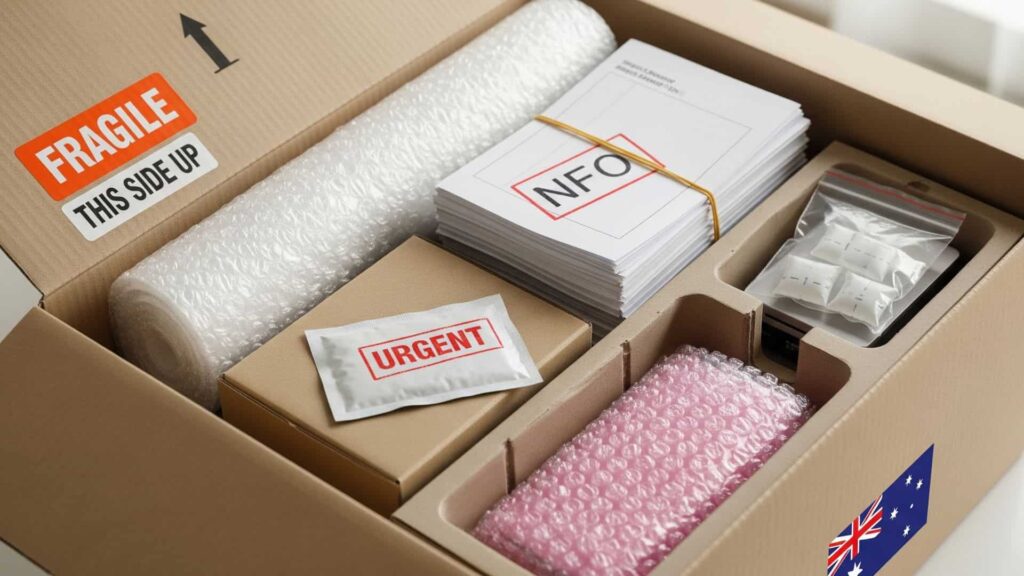
Need to get a parcel across Australia as fast as humanly possible? Time for next flight interstate.
Next-flight interstate courier services are the ideal solution for truly urgent deliveries.
Think critical documents, replacement parts, or time-sensitive medical supplies that simply can’t wait for standard shipping.
But here’s the catch: your parcel will only move as fast as its packaging allows.
Poorly packed items get flagged at depots, rejected by handlers, or arrive damaged at the other end.
Every minute counts when you’re racing to catch the next available flight. And the wrong box or a weak seal can mean your shipment misses its slot entirely.
Whether you’re a business shipping urgent inventory or an individual sending a last-minute gift across the country, these tips will help you get it right the first time.
Why Packaging Matters for Next-Flight Interstate Deliveries
When you book a next-flight courier service, your parcel enters a rapid processing pipeline.
It’s picked up, transported to an air freight depot, loaded onto the soonest available flight, and then rushed to the addressee on the other side.
That’s a lot of hands, conveyor belts, and cargo holds in a very short window.
Proper packaging is what keeps your parcel moving through each stage without delays.
Depot handlers assess parcels quickly. If yours looks damaged, poorly sealed, or non-compliant with weight and size limits, it gets pulled aside.
That could mean missing the next flight and waiting hours (or even a full day) for the following one.
Air freight handling is also rougher than you might expect. Parcels are stacked, shifted during turbulence, and rapidly unloaded.
Without adequate cushioning and build quality, fragile items are at serious risk. And unlike standard ground shipping, there’s very little room for error when every connection is time-critical.
The bottom line? Great packaging doesn’t just protect your item — it protects your timeline.
Choose the Right Box or Container
The box itself is the most critical line of defense for your shipment.
For next-flight interstate shipping, you need a container that can withstand the rigours of rapid air freight processing—including high-speed conveyor systems and the pressure of being stacked in a cargo hold—without buckling, tearing, or collapsing.
Selecting the Right Container
The industry standard in 2026 remains new, double-layered corrugated cardboard boxes, as these provide the necessary rigidity and crush resistance.
The box must be appropriately sized for the item, permitting at least 5 cm of cushioning space on all sides.
A box that is too tight risks crushing the contents, while one that is too loose allows for dangerous shifting while in transit.
For heavy items exceeding 12 kg, you should shift to heavy-duty reinforced cartons.
And if the parcel exceeds 25 kg, the safest practice is to split the shipment into multiple boxes or upgrade to a wooden crate for expensive or fragile goods.
Additionally, very small items—anything under 18 x 10 x 5 cm—should always be placed inside a larger outer box to prevent them from being lost or overlooked during the speedy sorting process.
Packaging to Avoid
Using old or previously branded boxes, such as those from Australia Post or DHL, is a major risk as it confuses depot handlers and can trigger unnecessary returns or misrouting.
You should also avoid flimsy gift boxes, plastic bags, or transparent wrapping, as none of these offer the structural strength required for the air freight environment.
Finally, never use bubble wrap as a standalone outer wrapper; while it is excellent for internal cushioning, it provides zero protection against the mechanical stresses of a transit network.
A good rule of thumb is that if you wouldn’t trust the box to survive a fall onto a conveyor belt, it isn’t the right choice for a priority shipment.
Cushion and Protect Contents Effectively
Once you’ve secured the right box, the next priority is immobilizing the contents.
Australian air transit in 2026 involves unique stresses. It often includes high-frequency engine vibrations, rapid changes in atmospheric pressure, and quick shifts during takeoff and landing.
Proper internal cushioning is your parcel’s primary defense, acting as a shock absorber that prevents the contents from bearing the force of impact.
Best Practices for Cushioning Delivery Parcels
For high-risk interstate shipping, every item should be individually wrapped using bubble wrap, foam inserts, or biodegradable air cushions.
Fragile objects like glass, electronics, or medical specimens require extra attention at their edges and corners, which are the most likely points to fail upon impact.
You should fill every void within the box with scrunched paper, packing peanuts, or air pillows until there is zero movement.
A simple “shake test” is the best diagnostic. Meaning, if you can hear or feel the contents shifting after the box is sealed, it needs more filler.
Advanced Protection Techniques
If you are shipping particularly delicate or expensive items, the double-box method is the professional standard.
This involves placing the item in a smaller, well-padded internal box and nesting that inside a larger shipping container with at least 5 cm of cushioning between the two.
For items with sharp edges or industrial components, ensure they are wrapped in heavy-duty material to prevent them from puncturing the box walls or damaging other parcels in the cargo hold.
By creating a totally suspended environment within the box, you ensure that even if the outer packaging is bumped or tilted, the product remains isolated from the shock.
A Word of Caution on Fragile Goods
It’s worth being upfront: fragile items always carry a degree of risk in courier networks, no matter how well you pack them.
Air freight is fast, but it’s not gentle.
If the item is irreplaceable or extremely delicate, apply maximum protection and seriously consider whether air shipping is the right choice — or whether hand-carrying it might be safer.
That said, with proper double-boxing and thorough cushioning, the vast majority of fragile items arrive safely. Just don’t cut corners here.
Seal Your Parcel Securely for Fast Handling
You’d be surprised how many shipments get delayed or damaged simply because they weren’t sealed properly.
READ: B2B E-Commerce and Same-Day Delivery: Meeting Business Customer Demands in 2026
A box that pops open mid-transit doesn’t just risk losing its contents — it can hold up the entire sorting process at a depot.
Parcels commonly get flagged at air freight depots for poor sealing.
A package that looks like it might open in transit will be pulled from the express queue for inspection or repackaging — and that means missing your flight window.
Label Clearly and Comply with Size and Weight Limits
Clear labelling is the final safeguard for your next-flight shipment.
The speed of air freight in 2026 leaves no room for ambiguity. Any parcel with an unreadable or conflicting label is immediately sidelined to prevent misrouting.
You must affix a clearly visible shipping label to the largest flat surface of the box, guaranteeing it is away from seams or tape that might cause it to peel.
It is critical to include full sender and recipient specifics, complete with postcodes and contact numbers.
Furthermore, you must remove or completely cover any barcodes or labels from previous shipments to prevent automatic sorting systems from sending your parcel to the wrong depot.
While “Fragile” stickers aren’t a guarantee of soft handling, they act as a necessary visual cue for ground crews to exercise caution during the fast-track loading process.
Navigating 2026 Weight and Size Limits
Every aircraft has a finite capacity, and next-flight services are regulated by strict physical constraints.
Before you seal your parcel, verify your courier’s specific weight and size limits; exceeding these can lead to immediate rejection or a forced downgrade to a slower road service.
Most priority networks prefer parcels under 25 kg for easier handling; if your shipment is heavier, splitting it into multiple cartons often ensures faster processing.
You should also be mindful of girth limits—calculated as length + (2x width) + (2x height)—as oversized items simply won’t fit into the standard air freight containers used for commercial passenger flights.
A parcel that hits every specification sails through depot checks, while an non-compliant one stays on the ground.
Strict Compliance with Prohibited Items
In 2026, air freight safety regulations—specifically about lithium batteries—are at an all-time high.
Beyond batteries, standard prohibitions remain absolute: hazardous materials, flammable liquids, toxic chemicals, and magnetized substances are strictly banned from passenger aircraft.
Guaranteeing your shipment is 100% compliant isn’t simply about following the rules; it’s about assuring the speed you’re paying for isn’t wasted at a security checkpoint..
Common Packaging Mistakes That Cause Delays
Even experienced shippers make packaging errors that cost them precious time. Here are the most common pitfalls to watch out for:
- Using old or branded boxes: Repurposed boxes with existing courier logos confuse automatic sorting systems and human handlers. This causes returns or misrouting — easily avoidable by using a clean, new box.
- Insufficient cushioning: Under-packed items shift, collide, and break. This leads to damage claims and delays while the courier investigates. Always do the “shake test” before sealing.
- Weak tape or poor sealing: Packages that open en route create handling incidents. Heavy-duty packing tape across all seams is essential — no shortcuts.
- Exceeding size or weight limits: Oversized or overweight parcels miss express processing slots. They’re either bumped to a later flight, rerouted to ground transport, or returned to the sender.
- Missing or unclear labels: Without clear addressing, your parcel can’t be sorted efficiently. Double-check every detail before drop-off or pickup.
Each of these mistakes is entirely preventable. A a few additional minutes of care during packing can save hours (or days) of delay on the other end.
How Zoom2u Makes Next-Flight Interstate Delivery Simple
Zoom2u takes the stress out of urgent interstate deliveries.
As Australia’s highest-rated courier platform — ranked #1 on ProductReview for 2022, 2023, and 2024 — Zoom2u connects you with trusted local couriers who can pick up your parcel and get it to the air freight depot fast.
Here’s what makes Zoom2u the ideal partner for next-flight shipments:
- Real-time GPS tracking so you know exactly where your parcel is from pickup to delivery.
- Adaptable booking options including 3-hour rush and same-day services, 7 days a week.
- Transparent pricing with no concealed fees — no fuel surcharges, no weekend penalties.
- Interstate same-day transfers via next-flight courier connections through services like Same Day Express and Urgent Express Courier.
- Easy online booking — schedule a pickup in minutes from your phone or computer.
Whether you’re a business rushing critical inventory to a client in another state or an individual sending an urgent package across the country, Zoom2u ensures your parcel gets there on the fastest possible timeline.
Ready to Send Your Next Interstate Parcel?
Proper packaging is the foundation of a fast, damage-free interstate delivery.
With the right box, thorough cushioning, secure sealing, and clear labelling, your parcel will move through air freight depots without a hitch and arrive at its destination intact.
Need to get something across Australia today? Book a delivery with Zoom2u and connect with a trusted courier who’ll have your parcel on the next available flight. It’s fast, transparent, and backed by Australia’s top-rated courier platform.
Managing regular interstate shipments for your business? Explore Locate2u to optimise your delivery routes, track your fleet in real time, and streamline your logistics operations from end to end.