Same day express is owned by zoom2u.

Transferring you now to the Zoom2u Booking Platform.

Some quick facts about Zoom2u:
  • 1. Australian Owned.
  • 2. We have processed over 2M deliveries via our platform.
  • 3. Highest ranked courier platform in 2022, 2023, 2024 on product review.

We are currently experiencing some technical difficulties with our phone lines, we are sorry for any inconvenience that may cause.

Meanwhile, please use our livechat function for any assistance you may need. Please note that our online booking system is working normally.

Ensuring Chain of Custody for Sensitive Same-Day Delivery Shipments

Ensuring Chain of Custody for Sensitive Same-Day Delivery Shipments

Managing same-day deliveries for sensitive goods isn’t easy.

When you’re racing against the clock to deliver pharmaceuticals, high-value electronics, or time-critical medical supplies, every handoff becomes a potential point of failure.

This is where chain of custody (CoC) becomes your most valuable operational safeguard.

It’s the chronological documentation and tracking process that records the handling, transfer, storage, and condition of goods from origin to delivery.

What Is Chain of Custody in Logistics?

Chain of custody is a verified record that documents exactly who handled your goods, when they handled them, where the handoffs occurred, and what condition the items were in throughout the journey.

Think of it as a complete audit trail that proves your shipment remained secure and unaltered from the moment it left your facility until it reached your customer’s hands.

For same-day shipments, this documentation becomes even more critical. The compressed timeframe often just hours from pickup to delivery means goods pass through multiple touchpoints rapidly.

Without proper chain of custody protocols, it becomes nearly impossible to identify where problems occurred or who bears responsibility when something goes wrong.

Why Chain of Custody Matters for Same-Day Delivery Orders

Same-day delivery compresses your entire supply chain into a matter of hours. While this speed delights customers, it also amplifies risks.

Rushed transfers, multiple handoffs, and tight schedules create more opportunities for unauthorised access, handling errors, or documentation gaps.

A robust chain of custody provides real-time visibility and a verifiable trail, whether physical or digital, that confirms custodians, timestamps, locations, and product conditions at every stage.

This is particularly vital for sensitive items that require temperature control, secure handling, or regulatory compliance.

Elements of Chain of Custody Documentation in Courier Delivery

In 2026, a solid Chain of Custody (CoC) is your legal and insurance safety net.

To keep your same-day deliveries moving without delays, you’ll need to capture these five pillars at every handoff:

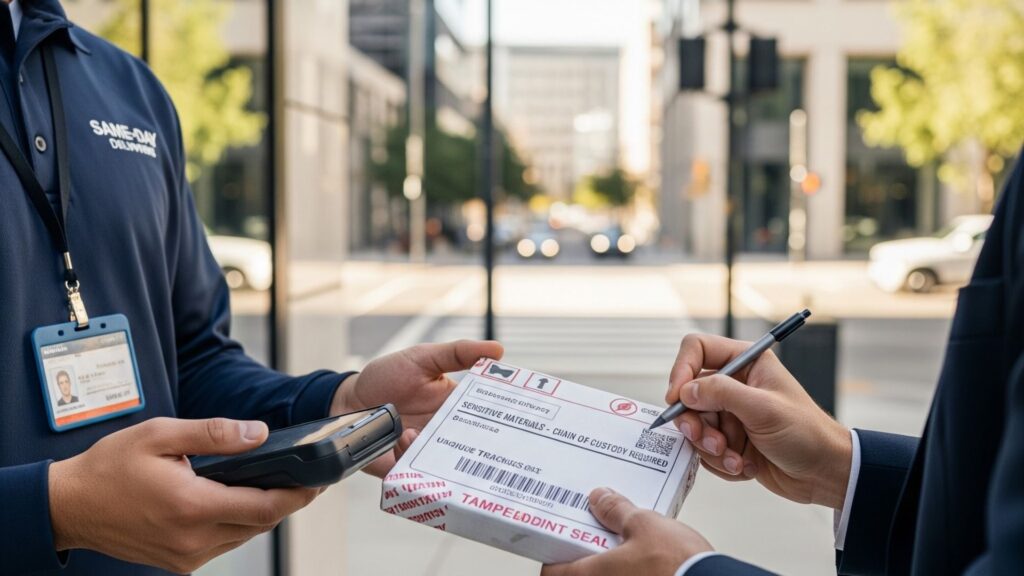
  • Detailed Description: List exact quantities, serial numbers, and tamper-evident seal codes.
  • Custodianship: Capture the digital ID or signature of every person who touches the freight.
  • Transfer Logs: Record the precise date, time, and GPS location of every handoff.
  • Verification: Use photos, barcode scans, and IoT sensor data to prove the item hasn’t been tampered with or damaged.
  • Anomaly Notes: Document any issues (like a scuffed box) immediately to avoid future disputes.

The goal is “Passive Accountability”: using mobile apps to log this data automatically so your drivers can stay focused on the road, not the paperwork.

4 Challenges and Chain of Custody Delivery Solutions

Same-day shipments move at a pace that often outruns traditional paperwork.

In 2026, the “haste vs. security” trade-off is being eliminated by digital protocols that embed accountability into the move itself.

1) Solving the “Rushed Handoff”

The pressure of a 3-hour window often tempts drivers and warehouse staff to skip formal sign-offs. In 2026, this is being solved by “Passive Accountability” tools.

Instead of manual forms, systems use GPS geo-fencing to trigger an automatic timestamp the moment a driver enters a delivery zone.

When combined with mobile e-signatures or biometric scans, the verification takes seconds—leaving no excuse for skipping the documentation that protects your liability.

2) Guarding Temperature Sensitivity

For pharmaceuticals or biological samples, same-day isn’t just about speed; it’s about Cold Chain integrity. In 2026, we’ve moved beyond checking a thermometer upon arrival.

IoT sensors now provide a continuous “heartbeat” of the shipment’s environment.

These sensors transmit real-time data to a central dashboard, triggering an automated alert if a vehicle’s refrigeration fails or if a package is left on a hot loading dock.

This allows you to intervene before the goods are compromised, rather than simply discovering the loss after delivery.

3) Mitigating Elevated Theft Risk

High-value items, like AI servers or luxury retail, moving through dense urban areas are prime targets for opportunistic theft. 2026 has seen the rise of Smart Digital Seals.

Unlike traditional plastic tags, these electronic seals are integrated with the vehicle’s GPS.

If the seal is broken or tampered with outside of a designated “Safe Zone” (the customer’s address), an immediate silent alarm is sent to dispatch.

This multi-layered approach makes unauthorised access detectable in seconds, not days.

4) Managing Multiple Parties

The complexity of same-day delivery often involves a “relay” between internal teams, third-party couriers, and the end recipient.

Maintaining a consistent CoC across different companies was once a nightmare of lost BOLs (Bills of Lading).

Modern API-first platforms now act as a single source of truth. Regardless of which courier is holding the parcel, the data flows into one centralised portal.

Choosing the Right Chain of Custody Model

In 2026, the Chain of Custody (CoC) is no longer just a paper trail; it is a digital shield that protects your business from liability and ensures the integrity of every shipment.

Choosing the right model depends on your specific regulatory requirements and the level of risk you are willing to manage.

Basic model: Manual and traditional

This model relies on physical signatures and paper forms. While it is cost-effective for very low-volume operations with no strict sensitivity requirements, it is increasingly risky in 2026.

The lack of real-time visibility and the high probability of human error make it difficult to defend in an audit or a dispute.

Digital model: Mobile and cloud-based

This is the baseline for most professional services today. It uses mobile apps to capture electronic Proof of Delivery (ePOD), timestamps, and photos.

Data is synced to the cloud instantly, allowing you to provide immediate documentation to your clients. It removes the “paperwork lag” and provides a reliable digital audit trail.

Advanced model: Blockchain and certification

For industries like legal, high-value retail, or sensitive government contracts, the advanced model uses blockchain technology to create an “immutable” record.

Every handoff is encrypted and time-stamped, providing an audit-proof certification that cannot be altered after the fact. This is the gold standard for regulatory compliance in the UK and Australia.

Integrated model: IoT and AI analytics

The most sophisticated approach involves a full Internet of Things (IoT) implementation. Sensors on the cargo monitor not just location, but also temperature, humidity, and even shock or vibration.

AI analytics then process this data in real time to flag any “handling exceptions” before they become a disaster.

This is the ideal solution for high-volume, same-day operations handling pharmaceuticals or fragile high-tech components.

The role of technology in maintaining delivery integrity

Modern logistics software has transformed CoC from a “compliance burden” into a seamless part of the driver’s daily workflow.

Technology ensures that the correct protocols are followed without the driver needing to be a compliance expert.

  • Route optimisation and protocols: Software doesn’t just find the fastest path; it ensures that sensitive shipments avoid “high-risk” areas or stay within specific geographical boundaries required by your insurance or the client.
  • Guided verification steps: Driver apps can be programmed with “hard stops”—meaning the driver cannot mark a job as complete until they have captured a specific photo, scanned a barcode, or verified an ID.
  • Automatic documentation: GPS tracking and geo-fencing build your documentation in the background. If a dispute arises, you don’t have to search for a file; you simply pull the digital log that shows exactly where the vehicle was and who was in possession of the goods at that precise second.

When these tools are unified within a single transport management system, the chain of custody becomes a natural byproduct of your operations.

You gain the visibility needed to address issues in real time, rather than discovering a breach three days later when it’s too late to fix.

Frequently Asked Questions

What goods require chain of custody documentation?

While any shipment benefits from proper documentation, chain of custody is particularly critical for pharmaceuticals, medical supplies, legal documents, high-value electronics, laboratory samples, and any goods subject to regulatory oversight or heightened security requirements.

How does digital chain of custody differ from paper-based systems?

Digital systems capture information instantly through mobile devices, integrate with GPS and IoT sensors for automatic documentation, and provide real-time visibility across your entire operation. Paper-based systems create delays, are prone to errors or loss, and make it difficult to identify problems until after deliveries are complete.

Can chain of custody protocols slow down same-day delivery?

When implemented correctly with modern technology, chain of custody documentation takes only seconds at each touchpoint.

What should I look for in a chain of custody technology partner?

Seek solutions that offer real-time tracking, electronic proof of delivery with photo and signature capture, IoT integration for condition monitoring, and seamless data sharing across all parties involved in your shipments.

Secure Your Chain of Custody Today

Implementing a tight chain of custody transforms same-day shipments from risky sprints into reliable operations.

You safeguard sensitive goods, protect your business from liability, and build the trust that keeps customers coming back.

Start by auditing your current documentation processes and identifying gaps. Adopt digital tools that capture verification automatically.

Ready for a deeper dive? Book a free operations review with our logistics experts and uncover quick wins for improving accountability, visibility, and security across your same-day delivery network.

Australia Wide express delivery platform, perfect for business or personal use.