Promising customers a same day service means that you need to provide exactly what you promised in as short a timespan as possible.
This can be challenging if your business does not have the necessary logistics in place to make the promise a reality.
And while online retailers have been offering same day delivery options for a while now, more and more comprehensive appliance repair services and same day appliance repairs service providers have joined.
These companies have now added a new promise alongside their already offered service. Both need to be fulfilled to ensure the best customer service provided.
Luckily, tools like implementing delivery zones can help. This blog explores this concept, as well as why partnering with a specialised delivery logistics service is beneficial.
Why Delivery Zone Expansion Matters (and When It Doesn’t)
Expanding zones extends your addressable market, boosts conversion rates in checkout, and improves repeat purchase rates. But longer distances add time, complexity, and cost.
The goal is to expand where demand and unit economics make sense, then protect your promise with the right tech, partners, and cut-off times.

1) Understand the Trade-Offs Before You Expand
- Urban vs. regional: High-density metro areas are efficient (shorter routes, higher drop density). Regional/rural deliveries often require more time and fuel for fewer stops.
- Service quality risk: As zones expand, late deliveries and damaged goods can creep up. Consistency is as important as speed for loyalty.
- Operational complexity: Longer routes, more traffic patterns, and multiple handoffs increase failure points unless processes and tech are dialled in.
2) Anchor Your Promise: Time-Based Zones That Scale
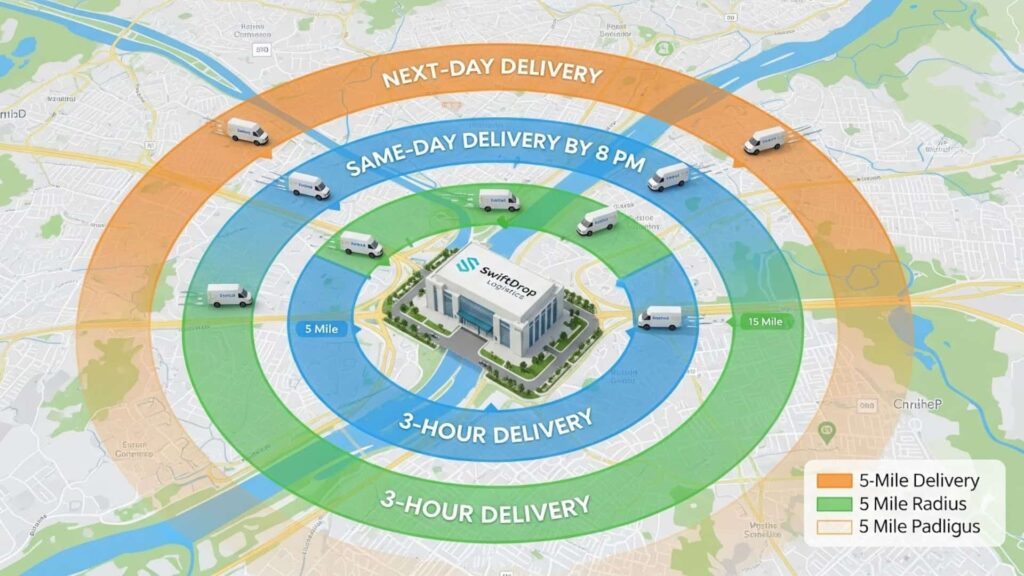
Define zones by time, not just distance. Customers buy outcomes (“by 8pm today”), not kilometres.
- Zone A (Priority): 3-hour rush within ~10–15 km of the hub during operating hours.
- Zone B (Same-day): Same-day by 8pm within ~25–35 km (or city-wide metro).
- Zone C (Edge): Same-day with earlier cut-offs or premium pricing up to ~50–60 km; otherwise next-day.
Pro tip: Lead with time commitments on your product pages and checkout. It sets clear expectations and reduces “where is my package?” anxiety.
3) Use Localised Fulfilment to Go Further, Faster
Micro-fulfilment and store-as-hub
- Micro-fulfilment centres (MFCs): Smaller, automated sites near demand clusters shorten pick/pack and drive-time windows.
- Store-as-hub: Turn retail stores into dual-purpose nodes. Faster order readiness = more time for the courier to hit same-day SLAs.
- Inventory placement: Stock high-velocity SKUs closest to demand; keep long-tail items centrally.
4) Optimise Routes and Visibility with the Right Tech
Route planning and dispatch
- Dynamic routing: Optimise by time windows, traffic, and vehicle capacity to reduce kilometres and fuel.
- Smart batching: Group nearby orders to improve drop density without blowing out ETAs. Real-time tracking and customer updates
- Live GPS tracking: Transparency builds trust and deflects WISMO (“where is my order?”) queries.
- Automated notifications: SMS/Email updates at pickup, en route, and delivery. Running your own fleet?
Locate2u provides GPS tracking, route optimisation, proof of delivery, and customer ETAs to keep your promise at scale.
5) Model the Economics Before You Add Postcodes
Build a simple unit-economics model
Gross margin per order minus delivery cost (base + per km + time) minus service/tech fees = contribution.
Set minimum order values or delivery fees by zone and service level (e.g., 3-hour rush vs. end-of-day).
Track first-attempt success rate and redelivery cost—missed deliveries can erase margins. Pro tip: Introduce “good-better-best” delivery options at checkout (3-hour, same-day by 8pm, next-day). Customers self-select speed versus price, improving both conversion and profitability.
6) Map Demand and Willingness to Pay
- Customer surveys & checkout tests: Gauge willingness to pay for 3-hour vs. same-day vs. next-day by suburb.
- Heatmaps: Identify clusters of high-value customers to prioritise new zones.
- Pilot pricing: A/B test delivery fees, free-delivery thresholds, and cut-offs by zone.
7) Set Cut-Offs and Operating Windows That Protect SLAs
- Cut-off times: Earlier cut-offs for edge zones preserve on-time performance.
- After-hours/weekend: Offer extended windows where demand is strong (events, gifting, healthcare).
- Peak management: Use surge capacity with trusted courier partners to ride demand spikes.
8) Choose Partners That Scale with You
For on-demand, point-to-point speed and transparent tracking, a dedicated courier platform is often more reliable than generic gig options.
Zoom2u: Fast booking, live GPS tracking, 3-hour rush and same-day options, 7-day service, and nationwide metro coverage. No hidden fees. Zoom2u has been the highest-ranked courier platform on ProductReview across recent years (as referenced by Same Day Express).
Interstate urgency: Zoom2u’s network can arrange next-flight solutions for time-critical, city-to-city transfers when speed truly matters. Zoom2u connects you with vetted local couriers and provides real-time visibility, giving both consumers and businesses confidence that urgent parcels will arrive when promised.
9) Pilot, Measure, Adjust: A 30–60–90 Day Plan
- Phase 1 (Days 1–30): Baseline and pilot Define Zone A/B/C and set cut-offs and fees. Pilot in 3–5 new suburbs with clear SLAs and promises. Instrument tracking and customer feedback loops.
- Phase 2 (Days 31–60): Optimise Tune routes, update inventory placement, refine fees by zone. Address failure points (missed pick-ups, long dwell times). Expand micro-fulfilment or store-as-hub if volume supports it.
- Phase 3 (Days 61–90): Scale Add suburbs with strongest demand and best unit economics. Introduce weekend/after-hours in proven areas. Formalise SLAs and service tiers with courier partners.
10) KPIs That Keep You Honest
- On-time delivery rate by zone and service tier.
- Cost per delivery and contribution margin by zone.
- First-attempt success rate and redelivery rate.
- Customer CSAT/NPS for deliveries (ask specifically about speed and updates).
- WISMO ticket volume per 100 orders (should decline with better tracking).
A Quick Decision Framework: Where to Draw the Line

If on-time rate ≥ 95% and contribution ≥ target → Expand the zone or hours.
But, if on-time rate 90–95% and contribution near breakeven → Optimise routes, cut-offs, and batching; consider raising the delivery fee.
And if on-time rate < 90% or contribution negative → Retract the zone or downgrade to next-day until fixes are in place.
Industry Examples: Who Benefits Most from Wider Same-Day Zones?
- Fashion and electronics retail: Event-driven purchases and urgent replacements; 3-hour delivery can lift conversion and reduce cart abandonment.
- Healthcare and medical supplies: Time-critical deliveries where reliability and tracking are non-negotiable.
- Automotive parts and trade: Downtime is costly—rapid delivery keeps jobs moving.
- Gifting and florists: Peaks on weekends and evenings; after-hours options delight customers.
Mini Case: A Melbourne Retailer
Extends to the East A boutique electronics store in Melbourne CBD piloted same-day to inner-east suburbs with a 2pm cut-off. Using store-as-hub fulfilment, live tracking, and 3-hour rush for VIP repairs, they achieved a 96% on-time rate and grew repeat purchases in the new zone. Expanding further east, they introduced a modest delivery fee and advanced cut-off to protect SLAs—and maintained contribution margins while increasing customer satisfaction.
FAQs
What’s the fastest way to deliver a parcel locally in Australia?
Use an on-demand courier platform with a 3-hour or direct-delivery option and live GPS tracking. Zoom2u provides priority pick-up, real-time updates, and vetted couriers for urgent point-to-point jobs.
How do I set fair delivery fees without killing conversion?
Offer tiered speed options (rush, same-day, next-day) and free delivery thresholds for slower tiers. For faster tiers, align fees to actual cost by zone and test price sensitivity at checkout.
When should I stop expanding my same-day zone?
When on-time rates fall below 90% for two weeks, or unit economics turn negative after optimisation. Maintain a next-day option in those postcodes until demand and density improve.
The Bottom Line
Expanding your same-day delivery zone can unlock serious growth—if you protect speed, transparency, and margins. Start with time-based zones, reinforce them with localised fulfilment and route optimisation, and measure relentlessly. With the right partner and tech stack, you can scale coverage without sacrificing customer experience.
Get Moving Today
B2C/B2B deliveries: Need something delivered today? Schedule a delivery with Zoom2u and get live-tracked, same-day service, 7 days a week.
Operating your own fleet? Discover Locate2u for route optimisation, real-time GPS tracking, and proof of delivery to improve on-time rates and cut costs.