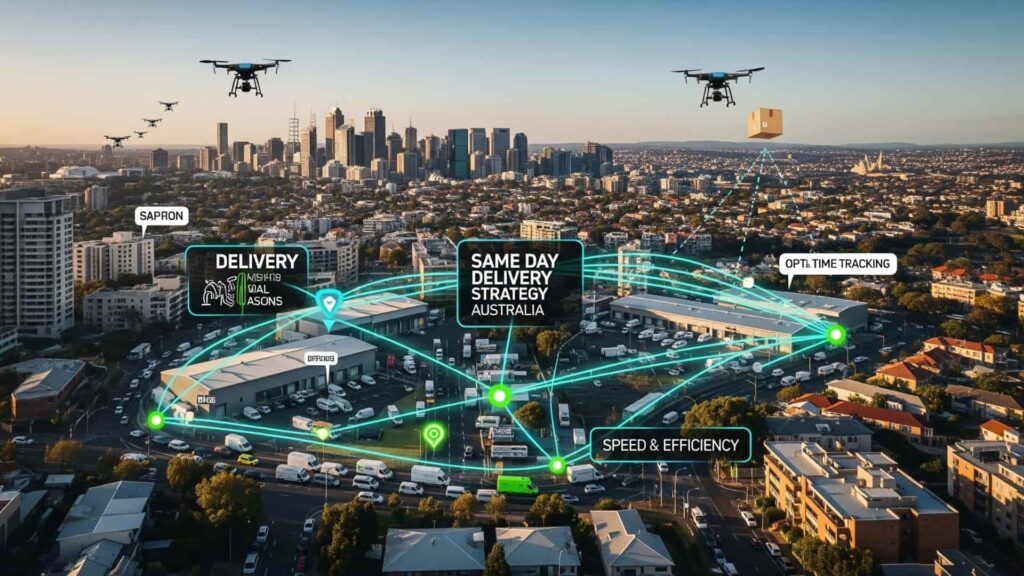
Clients expect exceptional same day delivery regardless of whether its a business day or not, and meeting tight deadlines while managing a growing client base isn’t easy.
For businesses serving other businesses across Australia, same day delivery has shifted from a nice-to-have perk to a genuine competitive differentiator.
But does the vast continent come with its own perplexing challenges, such as a vast geography, an irregular population density, and the operational complexity of delivering fast without absolutely blowing your budget up.
This guide walks you through building a same day delivery strategy that works for your business clients, whether they’re in Sydney’s CBD or regional Queensland.
Why Same Day Delivery Matters for Business Clients
Your business clients face their own pressures. When they order supplies, equipment, or inventory, delays can disrupt their operations, disappoint their customers, and cost them a lot of money.
The negative here is that they are all enough red flags to have them try working with other companies.
Same day delivery solves these problems by providing speed and reliability when it matters most.
The Business Case for Speed in Same Day Courier Delivery
Consider what rapid fulfillment means for your clients. In my experience, this means you should be thinking about:
- Reduced downtime: A tradesperson waiting on parts can get back to work the same day instead of losing billable hours.
- Better inventory management: Retailers can order stock as needed rather than tying up capital in excess inventory supplies.
- Competitive edge: Your clients can promise faster turnarounds to their own customers, such as fast same day delivery options.
For your business, offering same-day delivery creates tangible advantages too. Retailers like The Iconic have reported significant sales increases after introducing same day options in major cities.
When clients know they can count on you for urgent shipments, they’re more likely to consolidate their purchasing with you, and less likely to shop around.
Coverage Is Expanding Rapidly
Same day delivery now reaches 72% of Australia’s population, up from 63% in 2023.
Regional delivery shipping options are not much different, as same day delivery keeps extending beyond select areas and eligible postcodes. Now, everyone benefits, so it’s essential for your business to get on the wagon.
This expansion means more of your business clients can access rapid fulfillment, regardless of whether they’re in metropolitan areas or growing regional centres.
READ: Expanding Delivery Zones: Deciding How Far Your Same Day Service Should Reach
Assessing Feasibility Across Australia’s Geography
Australia’s size presents unique logistics challenges. What works in Melbourne’s inner suburbs won’t necessarily translate to serving clients in Toowoomba or Ballarat.
But your customers in all areas still deserve the best, and often expect their order delivered ASAP.
So I recommend that, before committing resources, you need a clear picture of where same day delivery makes sense for your business.
Urban vs. Regional Considerations for Same Day Delivery
| Factor | Urban Areas | Regional Areas |
| Coverage potential | High—dense populations support multiple daily deliveries | Growing via hub-and-spoke networks |
| Key challenges | Higher operating costs, traffic congestion, staffing competition | Greater distances, lower delivery density |
| Best opportunities | In-store fulfillment, gig courier partnerships | Scheduled shuttle runs, local courier alliances |
Start With Your Data
Before expanding your delivery capabilities, analyse your existing client data.
I’ve broken it down to three questions that are most valuable to businesses both looking into the same day delivery market and those already working with a provider.
- Where are your highest-value clients located? Prioritise areas with concentrated demand.
- What’s the typical order urgency? Some industries (healthcare, trades, hospitality) have more time-sensitive needs than others.
- What are your competitors offering? If rivals already provide same-day options in key markets, you may be losing business without realising it.
This analysis helps you identify where same day delivery will generate the preeminent return, as well as where it might not yet make financial sense.
Some Strategies for Implementation
Building a same-day delivery capability requires coordinating inventory, fulfillment operations, and last-mile logistics.
Here’s how I recommend your approach implementation
Optimise Inventory and Fulfillment
You can’t deliver what you don’t have on hand, so strategic inventory positioning is the foundation of reliable same day service.
This shouldn’t come as a massive surprise to those already familiar with some of the basics of the logistics industry.
Use predictive analytics for demand planning. Factor in regional variations, seasonal patterns (like state-specific school holidays), and local events that might spike demand. This helps you stock the right products in the right locations.
Consider micro-fulfillment options. Converting retail locations into fulfillment points—or using click-and-collect for same-day packing—can dramatically reduce delivery distances.
Chemist Warehouse, for example, checks in-store stock through their order management system to fulfill same-day orders from the nearest location.
Maintain real-time inventory visibility. When you can see stock levels across all locations instantly, you can split orders intelligently—sending items from whichever warehouse or store can fulfill them fastest.
Choose the Right Delivery Model
There’s no single correct approach to same day logistics. But if I were to make an educated guess on what a golden ticket would look like, I’d recommend these three options below:
Partner with delivery providers: Services like Sherpa, Drive Yello, and Zoom2u offer established infrastructure without requiring you to build your own fleet. This approach works well for businesses testing same-day delivery or those with variable demand.
Build in-house operations: If you have consistent high volumes in specific areas, dedicated drivers and route optimization may just prove more cost effective. You’ll have greater control over the customer experience, but you’ll also need to manage recruitment, training, and vehicle maintenance.
Adopt a ‘hybrid’ approach: Many businesses combine in house capacity for predictable routes with some gig economy platforms (think Uber) for overflow or hard-to-reach areas. This provides flexibility without the fixed costs of maintaining a large fleet.
You should ultimately note that the best model depends on your volume, geography, and existing capabilities.
READ: Managing Courier Relationships: Ensuring Reliable Weekend Deliveries
Leverage Technology and Partnerships
Technology is the glue that holds same-day operations together. The right systems can mean the difference between profitable rapid delivery and a logistical nightmare.
Technology components of the logistics and delivery industry include:
- Route optimization: AI-powered route optimization reduces drive time, fuel costs, and delivery windows. Even small efficiency gains compound across hundreds of deliveries.
- Real time GPS tracking: Both you and your clients should be able to see exactly where deliveries are at any moment (and this is a very real possibility)
- Dynamic promise calculators: Always show accurate delivery windows at checkout based on current drivers capacity, the inventory location, and traffic conditions.
- Automated notifications: SMS and email updates keep clients informed without requiring your team to make manual calls, and they’re not challenging to implement.
Key Tip: strategic partnerships matter too. Local courier relationships, alliances with shopping centres for pickup points, and connections with logistics technology providers can extend your capabilities without proportional cost increases. We’ve seen this first-hand.
Overcoming Key Challenges
It goes without saying that same day delivery isn’t without obstacles. Like all industries with many moving parts, and humans playing a key role, hiccups crop up.
But here’s how to address the most common issues businesses face.
Managing Costs Without Sacrificing Margins
Same day delivery costs more than standard shipping (especially bespoke options like on public holiday). The question is whether you can capture that value through pricing or operational efficiency.
- Premium pricing: Many business clients will pay more for guaranteed same day service. Test different price points to find the balance between uptake and profitability.
- Minimum order thresholds: Requiring a minimum spend for same-day eligibility ensures deliveries are worth the operational effort.
- Analytics-driven efficiency: Use data to continuously improve route density, reduce failed deliveries, and optimise vehicle utilisation.
Solving Inventory Complexity
Running out of stock at the wrong location absoluately kills same day delivery promises, and will leave clients at best annoyed and at worst liable to look elsewhere in the future.
Luckily, AI-powered forecasting can help predict demand more accurately, while flexible stock systems allow you to redistribute inventory based on real-time sales patterns.
Addressing Staffing and Capacity
Finding reliable drivers is an ongoing challenge. Gig economy platforms provide surge capacity, but you’ll need clear training protocols to maintain service quality regardless of who’s making the delivery.
Truly Growing Regional Coverage
Hub-and-spoke networks make regional same-day delivery viable. Central warehouses in growing centres like Ballarat, Toowoomba, or Newcastle can serve surrounding areas with scheduled daily runs, even if individual delivery density doesn’t justify dedicated local operations.
Steps to Launch Your Same Day Express Delivery Strategy
With all of the challenges our of the way, it’s time to look at practical means for you to launch the strategy for your business.
While the whole process is rather complex, and I would recommend partnering with a reliable company, there are five basic steps that can be followed.
1. Analyse Client Demand
Map your existing client base by geography and order urgency. Use purchase history to identify which clients would benefit most from same-day options, and which areas have enough density to make it viable.
2. Run a Pilot Program
Start in one or two high density areas where you can test operations without overextending. Partner with established delivery providers like Zoom2u to minimise upfront investment while you learn what works.
3. Integrate Technology
Deploy tracking, order management, and route optimization systems before scaling. Getting the technology right in a controlled pilot is far easier than fixing it across a national operation. I’d even recommend, if possible, that you try different options for different areas.

4. Communicate Clearly
Promote same day options prominently at checkout and train your sales team to highlight them with relevant clients. Make sure cut-off times, costs, and tracking information are crystal clear.
5. Monitor, Learn, and Iterate
Track fulfillment rates, delivery times, client feedback, and profitability. Use these metrics to refine your approach and always expanding what works and adjusting what doesn’t.
Positioning Your Business for Long-Term Success
Same day delivery isn’t just about speed. It’s a much more complex process.
And if it were just about speed, then they’d be far fewer players in the market.
I like to think that it’s about building the kind of reliability that turns one-time buyers into long-term clients.
Think about it. When your business clients know they can count on you for urgent needs, you become an essential part of their operations rather than just another supplier.
Frequently Asked Questions
What percentage of Australia can access same day delivery?
Same day delivery services now cover approximately 72% of Australia’s population, up from 63% in 2023. This coverage is concentrated in metropolitan areas but expanding into regional centres through hub-and-spoke distribution networks.
How can businesses offer same day delivery without building their own fleet?
Partnering with gig economy delivery platforms like Zoom2u allows businesses to offer same day delivery using established courier networks. This approach provides flexibility without the capital investment of maintaining an in-house fleet.
What technology is essential for same day delivery operations?
technology components include route optimization software, real-time GPS tracking, order management systems with inventory visibility, dynamic delivery promise calculators, and automated customer notification tools.
Is same day delivery viable for regional Australian businesses?
Yes is it, but through hub-and-spoke models. Businesses can establish central warehouses in regional centres and run scheduled delivery routes to surrounding areas. While individual delivery density may be lower, strategic planning makes regional same day service increasingly practical.