Same day express is owned by zoom2u.

Transferring you now to the Zoom2u Booking Platform.

Some quick facts about Zoom2u:
  • 1. Australian Owned.
  • 2. We have processed over 2M deliveries via our platform.
  • 3. Highest ranked courier platform in 2022, 2023, 2024 on product review.

We are currently experiencing some technical difficulties with our phone lines, we are sorry for any inconvenience that may cause.

Meanwhile, please use our livechat function for any assistance you may need. Please note that our online booking system is working normally.

The Role of Courier Services vs. In-House Drivers for Retail Same-Day Deliveries

The Role of Courier Services vs. In-House Drivers for Retail Same-Day Deliveries (1)

Courier services have changed the game for local businesses and small-scale e-commerce companies wouldn’t traditionally have had access to a wider customer base.

But their rise has resulted in more services, including some cheap courier services to large air freight services.

The right choice becomes tough when there are so many delivery solutions on the market.

And this can be improved, in part, when the businesses who rely on same-day delivery services better understand what they do.

One such feature, the debate between in-house and direct courier services, is explored in this blog.

In-House Delivery with Direct Couriers Services

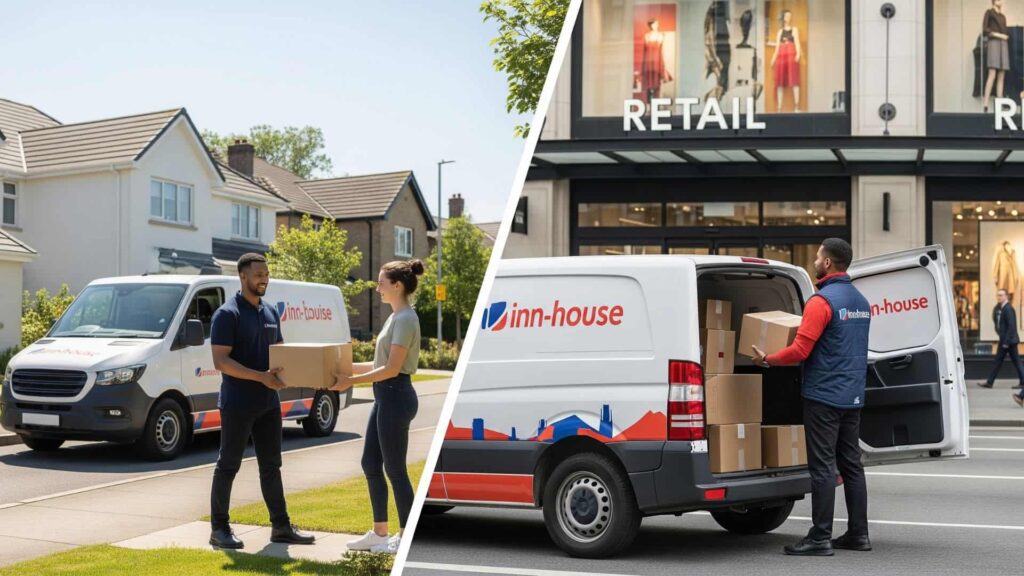
When you bring your delivery operations in-house, you’re essentially deciding that the last mile is too important to leave in someone else’s hands.

This is a courier services delivery choice which needs careful consideration.

It’s a move that buys you total control, but it also means you’re the one left holding the bag when things go sideways on a Tuesday morning.

Brand control and customer experience

The biggest win here is that you own the entire interaction at the doorstep.

You aren’t crossing your fingers hoping a third-party driver had a good morning; you’re the one controlling the training, the uniform, and the script.

Every time that van pulls up, it’s a mobile billboard for your business.

For high-end retail or premium services, that brand consistency is often the difference between a one-off sale and a lifelong customer who trusts the face at the door.

Speed and accuracy (when volume justifies it)

Dedicated teams have the luxury of learning your specific routes and your specific products. They know which loading docks are a nightmare and which customers need that extra bit of care.

Some data suggests in-house teams can actually squeeze out a 5-point lead on order accuracy compared to the big networks.

When your team isn’t juggling five different apps for five different companies, they tend to get the job done faster and with fewer “where’s my parcel” calls hitting your support line.

Specialised handling

If you’re shifting cargo that needs more than a “drop and go” approach, running your own fleet is often the only way to get a decent night’s sleep.

Whether it’s age-restricted gear that needs a rigorous ID check or high-end fragile items requiring a proper white-glove touch, those standards are a lot easier to enforce when the driver is actually on your payroll.

You aren’t just crossing your fingers and hoping they’ve followed the temperature-control protocols; you’re the one setting the sensors and physically checking the logs.

The Benefits and Trade-Offs Courier Delivery Services

Handing your logistics over to a courier service is the classic “set and forget” move, but it’s more of a partnership than a total hand-off.

You’re trading away a bit of that front-line control for a level of scalability that most in-house fleets can only dream of.

Reliability and flexibility at scale

The real power of a courier network is the sheer depth of the bench.

If an in-house driver calls in sick, you’re scrambling; if a courier in a massive network hits a snag, there’s a pool of hundreds of other drivers ready to pick up the slack.

This model gives you access to a range of service levels that would be a nightmare to manage yourself .

Just think 3-hour rushes, same-day evening drops, and those awkward after-hours or weekend windows that keep your customers happy while you’re actually at home.

Plus, if you need to move something bulky, perishable, or high-value, they usually have the specialised gear and the specific insurance to handle it without you needing to buy a new van for one-off jobs.

Technology and transparency

Today we’re all well past the days of “it’ll be there when it’s there.”

Modern courier platforms have poured millions into the tech side of things, offering real-time GPS tracking and live ETAs that do a lot of the heavy lifting for your customer service team.

When a customer can see the van moving on a map, they aren’t blowing up your phone with “where is my order?” anxiety.

Behind the scenes, those route optimization tools are constantly crunching numbers to cut down on idle miles, which keeps the whole operation leaning toward on-time performance rather than “best-effort” guesses.

Predictable, variable costs

From a P&L perspective, this is the safest play. You’re moving from fixed overheads to a “pay-per-delivery” model with clear, upfront pricing.

If a truck breaks down or a driver quits, that’s their headache and their cost—not yours.

It makes your margins a lot easier to predict because you aren’t subsidising a fleet that sits idle during the slow weeks.

When the peak season hits, you just scale up your bookings; when things quiet down in February, your delivery costs drop automatically without you having to lay anyone off or sell a vehicle.

Why Zoom2u Is the Simple Way to Start then Scale

The reality of modern retail is that “standard delivery” doesn’t cut it anymore.

Zoom2u gives you that on-demand speed across major metros, whether you need a 3-hour rush, a same-day drop, or someone to handle the after-hours and weekend slots that usually break a standard carrier’s brain.

It’s about being available seven days a week, and when the map gets too big for a van, the interstate same-day service uses next-flight couriers to bridge the gap.

The transparency side of the business is where you really save your sanity.

You get live GPS tracking and real-time notifications for both you and your customer, which does more for brand trust than a thousand marketing emails ever could.

It’s about killing that “where is my order?” anxiety before it even starts.

FAQs

What’s the fastest way to deliver a parcel locally?

If you’re looking to move something fast, an on-demand courier with a 3-hour or direct-drive option is the only real play. It cuts out the depot sorting and the double-handling, giving you the best balance of raw speed and total visibility.

How do I keep same-day costs under control?

Same-day doesn’t have to be a budget-killer if you’re smart about it. The best move is to set clear cut-off times and batch your pickups for an “evening” delivery. You should save those 3-hour rush bookings for high-value gear or genuinely time-critical orders.

Can I integrate delivery freight services with my operations?

Absolutely. You shouldn’t be manually entering addresses in 2026. Most serious retailers are pairing courier platforms directly with their own operations or route optimization tools.

This keeps the execution seamless and ensures that your whole team,from the warehouse floor to the customer service desk, has the same level of visibility on every single shipment.

Australia Wide express delivery platform, perfect for business or personal use.